
A surge in electric scooter injuries in recent years has prompted many K-12 schools and colleges to implement bans or significant restrictions on micromobility products.
Injuries associated with all micromobility devices — including e-scooters, e-bikes, and hoverboards — increased nearly 21% from 2022 to 2021, according to the U.S. Consumer Product Safety Commission’s (CPSC) report, Micromobility Products-Related Deaths, Injuries, and Hazard Patterns. From 2017 to 2022, e-scooter injuries rose from 8,566 to 56,847. Children 14 years and younger also accounted for about 36% of micromobility injuries from 2017 to 2022 despite only making up 18% of the U.S. population.
More recently, the U.S. Consumer Product Safety Commission’s (CPSC) National Electronic Injury Surveillance System (NEISS) found e-scooter injuries rose from just under 30,000 in 2020 to 118,485 in 2024 — nearly twice the 2023 total of 64,329.
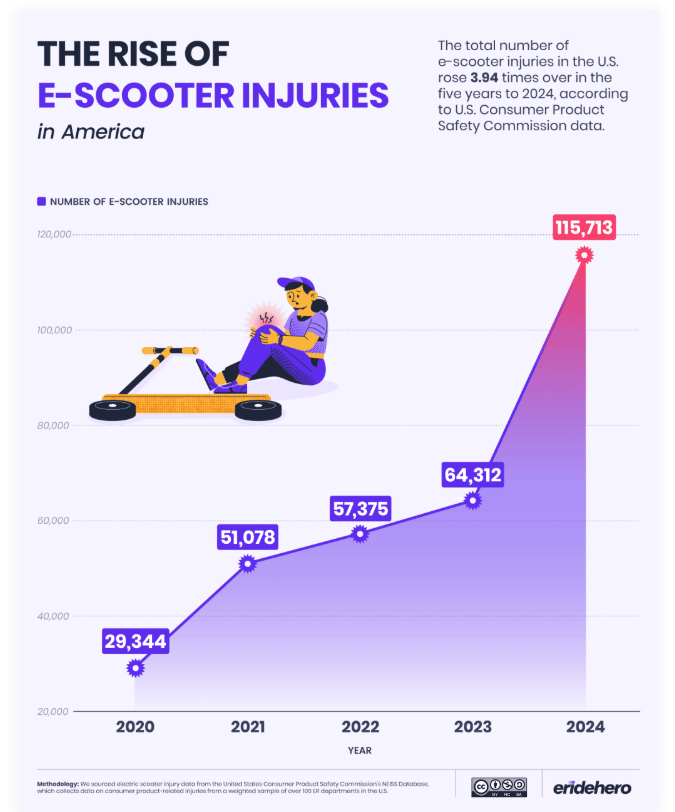
Graphic created by eridehero using data from the U.S. Consumer Product Safety Commission
Emergency departments across the United States have also documented significant increases in e-scooter–related hospital visits. According to a study from the American College of Surgeons (ACS), the annual cost of e-scooter and e-bike hospitalizations rising nearly five times over between 2016 and 2020 — from 6.6 million to 35.5 million — according to a study from the American College of Surgeons.
CPSC’s report says there were an estimated 360,800 emergency department visits related to all micromobility devices from 2017 to 2022. Of those visits, 169,300 (47%) were linked to scooters. The researchers also registered 233 micromobility-related deaths during that time frame, with nearly half (111) from e-scooter incidents, most commonly as a result of collisions with cars and/or control issues.
The increase in injuries coincides with the rise in e-scooter ridership, with the global e-scooter market valued at $48.9 billion in 2025. Personal e-scooter sales are growing with approximately 42 million units sold globally in 2024.
In the U.S., data from National Association of City Transportation Officials (NACTO) shows shared scooter ridership was up to 65 million in 2023, with the market reaching an estimated $751 million in 2025. In 2024, 130 cities offered shared scooter services, and about 8% of Americans said they had a private e-scooter available in their household, according to Statista.
E-Scooters Riskier Than E-Bikes, Research Shows
According to ACS’ findings, e-scooters are riskier than e-bikes. E-scooter injuries rose by 80% from 2020 to 2024, from 29,344 to 115,713.
Compared to bicycle-related injuries, scooter-related injuries more often require surgical management and are associated with greater risks of long bone fractures and paralysis. Hospitalizations for scooter-related injuries increased by nearly three-fold from 2016 to 2020, and more than half of those injured patients underwent major operations.
Compared with patients with bicycle-related injuries, patients with scooter-related injuries more often underwent major surgeries (55.8% vs. 48.1%), in particular orthoplastic procedures and operations on the head. Additionally, data from CPSC found that 20,960 (18.42%) of all e-scooter injuries in 2024 were head injuries, and 67.7% happened to males.
Other studies have shown that e-scooter riders are less likely to wear helmets and more likely to drink alcohol before driving compared to other forms of micromobility. One study of shared micromobility program riders in San Francisco showed less than 2% of injured e-scooter riders were wearing helmets.
Children Experiencing Higher Proportion of E-Scooter Injuries
Compared to bicycle injuries, patients who sustained injuries related to scooters were more likely to be under the age of 18 (26.7% vs. 16.4%), according to ACS’ findings.
The number of children under 14 injured by e-scooters doubled from 8,159 in 2020 to 17,641 in 2024. The proportion of all e-scooter injuries happening to children also rise from 12.69% to 15.26%.
RELATED ARTICLE: Top 10 Risks Facing K-12 Schools
Broken down further, the data shows the following:
- Injuries among those under 6 rose 2.39 times
- Injuries among those under 11 rose 2.95 times
- Injuries among those under 15 rose 4.85 times
Daniel Rosenfield, a pediatric emergency physician, told CBC that some parents who have gifted their children e-scooters don’t realize that they can go from zero to 40 km/h in seconds.
““From an emotional and cognitive perspective — where you just have the ability to understand where your body is in space, how you can make turns, what’s far ahead and what’s not — [it is] similar to driving a car,” he said.
Drinking and Riding E-Scooters
Of 115,713 e-scooter injuries in 2024, 2.17% (2,515) involved recreational drugs and 7.52% (8,699) involved alcohol. A study from North Dakota State University found that compared with adults under 40, children ages 10 to 17 had 7.5 times greater odds of emergency department visits that involved drinking.
Alex Engel, a spokesperson for NACTO, told Yahoo that most of the e-scooter injuries are sustained by riders, who are vulnerable to potholes or small objects on the road.
“With e-scooters, the center of gravity is much higher because you’re standing on them, and because the wheels are much smaller and there’s in general much less shock (absorption), pavement quality tends to matter a lot more than it does for bikes or e-bikes,” he said.
Which Schools Have Banned Electric Scooters?
While the list is expected to rapidly grow in the coming months, here are some schools that have already limited or banned the use of e-scooters and/or e-bikes on their campuses.
1. Shrewsbury (Mass.) Public Schools Bans E-Bikes, Scooters
Shrewsbury Public Schools Superintendent Joe Sawyer announced late last year that e-bikes and scooters would be prohibited on all school campuses starting Nov. 6, according to Community Advocate.
“Over the course of this fall, we have experienced several situations where students riding motorized e-bikes have been involved in unsafe situations that endangered both those riding and others,” Sawyer wrote in an email to school families. “I, along with other school leaders, have become increasingly concerned about the potential for serious injury or worse due to e-bikes’ speed, difficulty for drivers to see and avoid them, and heightened risk of accidents to riders, pedestrians, and vehicles.”
Sawyer says he consulted with the Shrewsbury Police Department before making his decision.
2. Menlo Park (Calif.) City School District Restricts E-Bikes, Scooters
In Dec. 2025, Menlo Park City School District announced a new policy prohibiting students under 16 from bringing e-bikes capable of exceeding 20 miles per hour or operating without pedaling onto school campuses.
The initiative aligns with similar measures taken by Marin County, which passed an ordinance in March barring minors from using throttle-powered e-bikes in unincorporated areas. The ordinance also mandates helmet use for all Class 2 e-bike riders, reports the San Francisco Chronicle.
Which Colleges Have Banned Electric Scooters?
Below are some college and university campuses that have fully banned e-bikes and e-scooters.
Yeshiva University
Yeshiva University, which has four campuses throughout New York City, was an early adopter of an e-bike and e-scooter ban, adopting a policy in Aug. 2023. The decision was made due to the threat of fire from lithium-ion batteries in these devices, which led to at least 14 deaths that year, YU Commentator reported. There were also 19 deaths associated with fires between Jan. 1, 2021, and Nov. 28, 2022, according to the U.S. Consumer Product Safety Commission (CPSC).
The policy was developed by the university’s security, risk, legal, and human resources departments in conjunction with the Office of Student Life. It applies to faculty, students, staff, and visitors but allows for case-to-case exemptions for research of accessibility purposes.
New York University (NYU) and Columbia University, also in NYC, have similar policies in place.
University of Illinois Chicago
The University of Illinois Chicago (UIC) was also an early adopter of an e-bike policy. Approved by the school in Dec. 2020, the policy “prohibits the use of e-scooters and other low-speed, motorized personal transportation devices on university premises and in university facilities.”
The policy does not apply to wheelchairs or ADA-related mobility aids. Students are allowed to use their personal transportation devices to get to and from campus but they “must be docked at designated parking locations when on campus.”
Which Colleges Have Restrictions on E-Bikes, E-Scooters?
Many colleges and universities have issued partial bans or restrictions on micromobility devices. Some allow e-bikes but not e-scooters, and others simply restrict storing or charging the devices inside campus buildings. Here are some examples.
Boston College
Boston College banned electric scooters, electric skateboards, and hoverboards starting in Dec. 2022. The policy specifically prohibits the use, storage, and charging of electric scooters and similar electric transportation devices on all BC property.
However, electric bicycles can still be used on campus provided that users follow all applicable traffic regulations, do not bring their e-bikes into any BC facility, and secure them in outdoor bike racks.
University of Notre Dame
The University of Notre Dame banned personal electric vehicles (PEVs), including e-bikes, e-scooters, and e-skateboards, from campus in late 2023.
Campus community members who commute to the school using an e-bike may continue to do so as long as they operate the bike in traditional, pedal-only mode, without any electric assistance, while on campus. Those bikes must also be registered with campus police and must clearly display a registration tag.
The school’s policy also prohibits the charging of e-bikes on campus.
Robert Morris University
Robert Morris University in Pittsburgh banned electric scooters, hoverboards, and Segways from RMU properties beginning Oct. 2025. The school says the devices cannot legally be operated on public roads and sidewalks, citing Pennsylvania law.
E-bikes or other devices with “documented need” are still permitted on campus. However, they cannot be stored or charged in university facilities.
Princeton University
Effective Jan. 25, 2024, personal electric vehicles, electric scooters, and other electric micro-mobility devices, such as hoverboards and electric and motorized skateboards, were prohibited to be used, stored, parked, or charged on the Princeton University campus.
RELATED ARTICLE: Improving College E-Bike Safety: What Admins Can Do
E-bikes are permitted but must follow New Jersey laws, which require e-bikes be registered with Transportation and Parking Services, among other things.
Other campuses with restrictions include:
Creating E-Scooter Policies for Your Campus
School leaders play a critical role in shaping safety policies that protect students, staff, and visitors. Creating effective safety policies requires thoughtful and intentional planning, balancing the need for security with maintaining a welcoming, supportive school environment.
A 2025 survey of college campus leaders, conducted by UL Standards & Engagement (ULSE) and the League of American Bicyclists, found 70% of campuses report safety concerns around e-bikes and e-scooters. However, only 9% have developed comprehensive policies.
Administrators must act now to balance access to this efficient mode of transportation with proper safety measures,” Anna Schnerre, Senior Quantitative Insights Analyst at ULSE, told Campus Safety. “By prioritizing the development of robust policies for the safe use of e-bikes and e-scooters, enhancing e-mobility infrastructure, and improving student education, administrators can create a safer transportation experience on campus.”
For campuses considering limiting or banning e-scooters or other micromobility devices, United Educators (UE), which provides liability insurance and risk management services to U.S. schools and colleges, recommends the following policy considerations:
- Require properly fitted helmets, reducing the potential for serious injuries or fatalities
- Identify scooter-free zones through proper signage and continued communication
- Ban scooters from campus buildings as the battery may create a fire and explosion hazard, particularly while charging
- Encourage safe charging practices, such as only using the supplied charger and never leaving the device unattended while charging
- Establish a speed limit
- Ban use for people under the influence of alcohol or drugs
- Limit riding in dangerous conditions, such as severe weather or after dark
- Create parking guidelines, such as prohibiting parking in pedestrian pathways, in vehicle parking spaces, or on lawns
- Establish sanctions for policy violations, such as temporarily confiscating scooters parked in prohibited locations
- Work with legal counsel to understand local laws regulating e-scooter use; some jurisdictions ban e-scooters on roads
For campuses that partner with e-scooter sharing companies, UE’s recommendations for creating those contracts can be found here.