

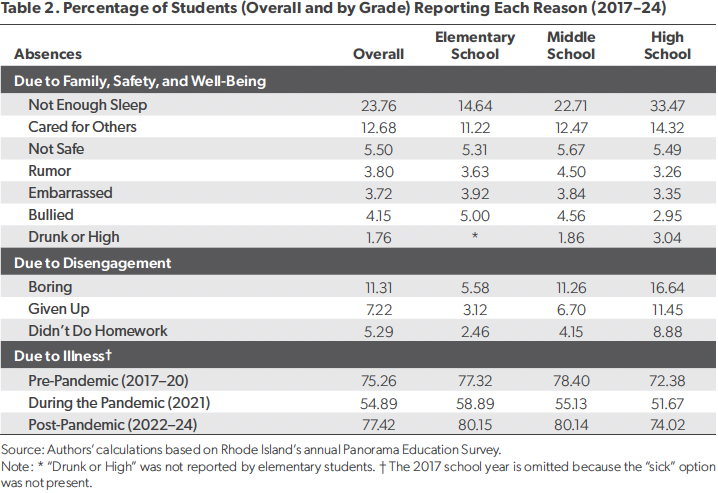
A report on absenteeism in Rhode Island schools found 5% of students have missed school due to safety reasons.
Chronic absenteeism is defined as missing more than 10% of school days in a year for any given reason. It dramatically increased during the pandemic and remains concerningly high throughout the U.S., affecting nearly 25% of all K-12 students. Although Rhode Island’s rates have decreased over the last few years, they remain above pre-pandemic rates. During the 2024-2025 school year, 22% of Rhode Island students were chronically absent, according to The Brown Daily Herald.
Related Article: Curbing Chronic Absenteeism: Successful School Attendance Strategies Revealed
The research, conducted by the American Enterprise Institute (AEI), aims to reduce chronic absenteeism by understanding the reasons why students miss school. Researchers used annual survey data from the Rhode Island Department of Education from 2017 through 2024 school years. The surveys, administered online between Martin Luther King Jr. Day and March 31 of each year to all students between grades 3-12 in every Rhode Island public school, asked students to self-report their reasons for missing school.
While the students reported 11 reasons for missing school, the researchers say four stood out due to their high rates or their post-pandemic increase:
- Illness
- Lack of sleep
- Boredom
- Safety concerns
Middle Schoolers, Students in High-Poverty Schools Feel Least Safe
Roughly 5% of all students reported safety-related absences, with middle schoolers and students in high-poverty schools consistently reporting the highest rates. The report also found concerns for issues including feeling unsafe, bullying, and embarrassment increased among elementary and middle school students post-pandemic.
Although the increases are “small and unlikely to account for a large portion of the rise in absenteeism” in Rhode Island, it “does reflect a meaningful shift in student experiences, particularly in high-poverty schools, where students reported nearly double the rates of safety-related absences,” the researchers wrote.
Related Article: How Untreated Student Mental Health Impacts Academic Achievement, School Safety, and Teacher Retention
Conversely, high school students reported slightly lower rates of safety-related absences, which remained largely stable from pre- to post-pandemic.
“Taken together, our findings point to both continuity and change in the reasons for students missing school from pre- to post-COVID,” said the researchers. “Although illness and lack of sleep remain the most common challenges reported by students in Rhode Island, rising rates of disengagement, particularly among elementary and middle school students, and the growing safety concerns across both groups suggest deeper and more systemic challenges that should be addressed post-COVID.”
17 States Pledge to Reduce Chronic Absenteeism
Attendance Works, along with EdTrust and AEI, have launched a national chronic absence challenge, calling on states to reduce chronic absence by 50% in five years. Education leaders from 17 states have committed to the challenge so far. Those states include:
- Alabama
- Arkansas
- California
- Colorado
- Connecticut
- District of Columbia
- Georgia
- Indiana
- Iowa
- Maryland
- Nebraska
- New Mexico
- Ohio
- Rhode Island
- Virginia
- Washington
- West Virginia
The organizers have created a toolkit for state leaders that is “designed to support their work on a statewide student engagement and attendance plan tailored to their local circumstances.”