
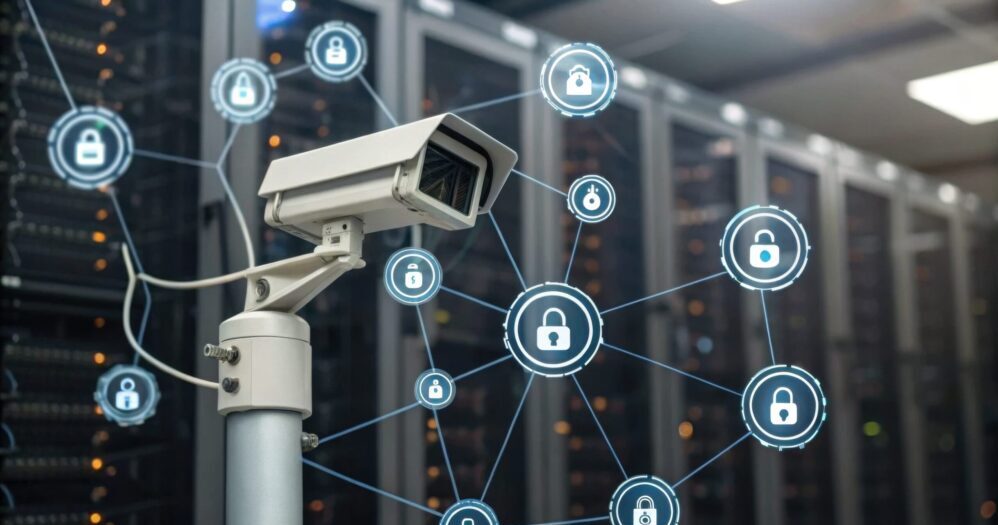
Artificial intelligence (AI) is reshaping the landscape of video surveillance. Many organizations are racing to incorporate AI into their systems, not just to stay competitive but to stay ahead of rising security challenges. Falling behind could mean missed opportunities for faster threat detection, streamlined operations and smarter decision-making.
The physical security industry is well-suited for AI adoption. Video surveillance systems generate enormous amounts of rich data that AI thrives on. From detecting anomalies in real time to automating analytics across hundreds of cameras, AI promises to reshape how organizations protect people, property and assets.
Related Article: AI Video Detection in Schools: How Automated Surveillance Reduces Emergency Response Time
However, incorporating AI is not as simple as it may seem. Legacy infrastructures still linger throughout the industry, and these older systems are not equipped to support AI workloads. Limited storage and antiquated architectures can create serious inefficiencies and time lags that hinder AI’s true potential and usefulness.
That’s why forward-looking campuses are turning to the cloud. Migrating video surveillance systems to the cloud not only enables AI adoption, but also addresses scalability, speed and security in ways traditional infrastructure simply cannot.
Scalability in Cloud Storage for Video Data
Scalability is key to designing systems that grow with campus needs. AI systems don’t just require data at the point of analysis but depend on vast amounts of data throughout the entire lifecycle: training, deployment, inference and long-term improvement.
At the beginning of this lifecycle, surveillance video must be captured, indexed and stored. Cloud storage makes it possible to scale up or down instantly based on need. Unlike on-premises systems, the cloud ensures organizations never run out of capacity. This flexibility is critical in video surveillance, where data volumes can spike during high-traffic events or emergencies.
Once the content is securely stored, it becomes an invaluable dataset for AI training. Historical video is particularly powerful for teaching AI to recognize patterns, anomalies, or rare incidents. The more diverse and long-term the dataset, the more accurate the AI becomes. Cloud storage makes this possible by retaining video in the right, cost-effective storage classes, ensuring data is always accessible when needed without overwhelming budgets.
Once the new systems are in place and trained properly, the cloud can also be used to store any and all insights AI generates. As a result, cloud scalability helps campuses adopt flexible AI-enabled solutions that can easily expand as surveillance networks grow.
Accelerating Real-Time Threat Detection with AI
Performance and responsiveness are top priorities, and AI only amplifies this need. When an AI system detects suspicious behavior, an unauthorized entry or a potential safety threat, security teams need instant visibility and the ability to act. This becomes even more critical once AI systems are deployed.
Putting AI systems and analytics directly on cameras enables users to have immediate updates on potential security issues that need to be addressed in real-time. By combining the fast speeds of the cloud with the powerful analytics of AI, security operations can move faster than ever before.
Related Article: How AI Video Analytics Transforms Campus Safety, Efficiency and Compliance in Schools and Universities
The ability to search and index petabytes of video is another game-changer. AI can automatically tag people, vehicles, objects and events, making it dramatically easier to sift through footage that would otherwise take hours or days to review manually. This translates into a clear value proposition: systems that not only record video but provide actionable intelligence on demand.
Maintaining Data Security and Compliance in the Cloud
When it comes to video data, security professionals know that protecting footage is just as critical as capturing it. Compliance with retention regulations and privacy requirements is paramount non-negotiable. The cloud helps organizations meet these requirements while also reducing risk.
Modern cloud storage platforms provide end-to-end protection for video surveillance data. Encryption safeguards content both in transit and at rest, ensuring that video streams cannot be intercepted or tampered with.
Features like immutability, which prevents footage from being altered or deleted, create a secure archive that aligns with regulatory requirements. This is critical not only for cyber-resilience but also for maintaining trust in surveillance systems.
Related Article: Why Schools and Universities Are Cybercrime Hotbeds
Cloud systems also provide built-in redundancy and disaster recovery. If a local server fails or a data center goes offline, footage stored in the cloud remains accessible and intact. Additionally, having copies of data stored in the cloud ensures that content is protected in the event of accidental deletion or a ransomware attack.
The cloud keeps data protected throughout the entire AI lifecycle and for the length of the retention mandates. Cloud-backed systems can help campuses meet regulatory standards while reducing on-site maintenance and storage costs.
Implementing new systems, especially ones as transformative as AI, can be daunting. It requires assessing your infrastructure, identifying gaps and rethinking workflows.
But campuses don’t need to adopt an all-or-nothing approach. Many are finding success through a hybrid method, gradually migrating storage to the cloud while layering in AI capabilities over time, while still maintaining some on-premises systems.
Over time, as confidence grows and AI adoption matures, the cloud can take on a larger role as the central hub of the surveillance ecosystem.
The decision to embrace the cloud is about more than keeping up with tech trends. It’s about preparing for the future of physical security where AI enables security solutions to make communities safer and businesses more secure.
Danny Collins is senior product marketing manager at Wasabi. This article was originally published in CS sister publication Security Sales & Integration and has been edited.
Note: The views expressed by guest bloggers and contributors are those of the authors and do not necessarily represent the views of, and should not be attributed to, Campus Safety.