
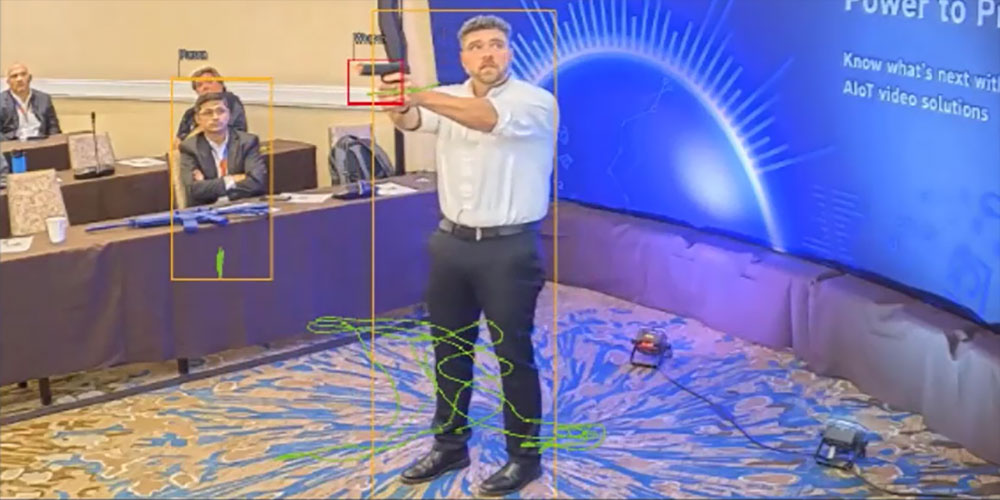
With the U.S. experiencing so many violent incidents on campuses, prevention is critical for administrators who must keep students, faculty, and staff safe while fostering environments that encourage favorable learning outcomes. Fortunately, advances in AI-enabled visual gun detection are helping campus safety personnel to detect threats earlier, which may enable faster response times to incidents on campus.
Related Article: Survey Reveals Strong Public Support for Gun Detection Technology in Schools and Workplaces
When a person brandishing a gun approaches a building, edge-based video analytics are designed to promptly alert personnel who can verify the gun and take proactive measures. The near-invisible camera-based system elevates the security and safety of campuses while enabling a smooth, frictionless flow and welcoming atmosphere that promotes learning. Simultaneously, it ensures security staff have access to high-quality video footage of the threat to provide improved situational awareness to first responders and detailed recordings for video evidence after the event.
New Systems Achieve Reliable Gun Detection
Currently, edge-based, AI-enabled visual gun detection works best with two cameras focused on a funnel point that covers less than 30 feet, with 20 feet wide being the ideal distance. To achieve success in detecting a small handgun, a significant number of pixels from the camera should cover a small space. Having two cameras at each funnel point is important to maximize the probability of detection, regardless of where the individual points the gun. If the barrel of a gun points at one of the cameras, there is little of the gun visible for the camera to see and detect. However, the second camera will capture the gun from the side to improve detection. Only one of the two cameras camera needs to see and detect the gun to trigger an alert.
Funnel points can be outdoors at approach points to buildings, at campus main gates, or at entrances to main quads. When outdoors, the area should have adequate lighting at night to increase detection capabilities of guns that are dark grey or black. Funnel points can also be indoors in lobbies, at entrances to gathering points such as dining halls or student unions, or at doorways into auditoriums or gymnasiums.
Grapevine-Colleyville Independent School District (GCISD) recently evaluated gun detection technology for the district.
When testing, “key priorities included accuracy in identifying threats, low false-alarm rates, integration with existing systems, and ease of use,” said Allen Smith, GCISD Director of Emergency Management and School Safety. “These criteria ensured that the technology could perform reliably in an active K-12 environment.”
Continued improvements in visual gun detection have resulted in high accuracy rates. As with all video analytics, success is measured with accurate detections and low false positive rates. The analytics should not trigger on items like cell phones, cups, or umbrellas, held by individuals as they walk through a campus. Some systems have reached a high level of accuracy with only 0.005 percent of alerts triggered by false positives. That translates into one person out of 2,000 passing through a funnel point who is carrying an object the camera inaccurately detects as a gun. Statistically, a false positive rate of 1 in 2,000 is very good but not perfect.
How Cloud-Based Verification Reduces False Alarms
More recently, the availability of cloud-based AI alarm verification adds a second pair of eyes to check questionable alerts. It operates like instant replay technology in football games. The edge-based visual gun detection makes the call on the field and sends a short clip of that detection to the cloud for a replay review. AI alarm verification acts like a referee to confirm potential threats or overturn the call. It quickly rescinds or escalates alarms by the edge-based technology via the cloud, reducing false positives even further.
Related Article: Poor Policies and Over-Reliance on AI Can Sabotage Your Security Technology’s Potential
This additional verification is especially valuable for campus safety personnel who may be managing alarms from multiple funnel points, allowing them to focus on critical moments, improve decision-making, and speed response times. For locations that see a high-volume of people, such as entrances with 2,000 to 3,000 people passing through every day, this layer of verification helps to achieve even greater accuracy and reduce the chance of alarm fatigue. Accuracy is essential for campus safety personnel to trust that an alarm is an event that needs their full attention.
Combining edge-based detection with cloud-based verification enables a secure default approach. The system can be configured to immediately lock the doors when the edge-based AI detects a gun to prevent the individual from gaining access to the building or gathering area. That detection goes to the cloud for review. If the cloud service rescinds the alarm, doors unlock. If it verifies the alarm, the doors remain locked and other responses can be triggered. This combination offers the best of both edge and cloud-based approaches to visual gun detection. Campuses benefit from the speed and scalability of edge-based technology with the ability to further filter out false positives achievable through cloud-based AI verification.
Integrate Audio Analytics for Layered Security
Pairing cameras equipped with edge-based audio analytics along with visual gun detection creates a layered approach in these areas. If a gun is not visually detected, audio analytics is designed to detect gunshots up to 75-100 feet from the camera while accurately estimating the direction from which the sound originates – whether in or near a building or parking lot.
The analytics in advanced systems can detect gunshots from more than 20 different calibers of guns. Like visual gun detection, camera-based gunshot detection adds the benefit of capturing video for enhanced situational awareness. Combining audio analytics capabilities with visual gun detection may enable quick and appropriate responses in critical situations.
The Future of Visual Gun Detection Technology
Continued development in visual gun detection will soon extend the distances at which a brandished gun can be detected. Extending the distance further away from entrance points with longer-range visual-gun detection can give personnel more time to react to an event in which every second counts.
While visual gun detection can operate independently, it can also integrate with video management systems (VMS), access control and public address solutions, or two-way radio systems used by first responders. There are multiple notification paths that can occur after a detection. If there is no operator sitting in front of a screen monitoring video, notifications need to reach a person or people who are moving throughout the campus, such as a school resource officer, campus safety personnel, or an administrator. As a result, push notifications to phones or automated messages to two-way radios are effective paths on campuses.
Related Article: AI Video Detection in Schools: How Automated Surveillance Reduces Emergency Response Time
With integration of visual gun detection in the VMS, the system can be configured to automatically track the individual moving through the fields of views of nearby cameras. Responses and workflows can also be defined. This integration is just one response layer to a detection. Other integration paths enable additional responses like human verification, initiating automated public address announcements, and dictating smart lockdown and evacuation protocols.
The Benefits of a Frictionless System
Transparent and frictionless solutions, like visual gun detection, help to create environments that are conducive to learning. Students and staff do not necessarily see the extra layer of safety, but it is there. The goal is to maintain an environment that is safe and feels safe, so students can focus on learning, and teachers can provide more effective instruction, resulting in improved learning outcomes.
Craig Oberschlake is Business Development Manager for Education, State and Local Government, Bosch Video Systems.
Note: The views expressed by guest bloggers and contributors are those of the authors and do not necessarily represent the views of, and should not be attributed to, Campus Safety.