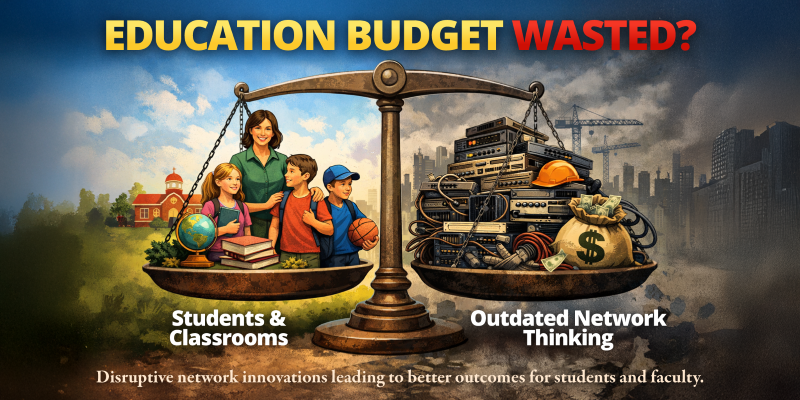
In our previous Campus Safety article, we discussed how outdated assumptions about network readiness are quietly undermining modernization efforts across education. This follow-up explores an even more urgent dimension of the issue: the enormous financial impact of ripping and replacing existing network infrastructure based on outdated design thinking and traditional switch limitations, and how those savings could instead be spent supporting teachers, students, and safer learning environments.
Digital Transformation Is Essential… but It’s Becoming a Budget Trap
Across North America, public school systems are under intense pressure: chronic underfunding, larger class sizes, aging facilities, staffing shortages, and a growing need for modern learning technology. At the same time, schools are investing heavily in digital transformation to improve:
- Campus safety and situational awareness
- Real-time communications
- Smart learning environments
- Advanced student services
These initiatives rely on IP-based devices: cameras, phones, access control systems, intercoms, and sensors. When implemented correctly, they strengthen safety, accelerate emergency response, and enhance student engagement. But a major, and often unrecognized, problem sits at the foundation of these efforts: the prevailing assumption that IP modernization requires a full rip-and-replace of existing network infrastructure, resulting in:
- Large-scale construction
- Costs that grow far beyond initial estimates
- Multi-year disruption
- Greater cybersecurity risks
- Significant strain on understaffed IT teams
Most importantly, these assumptions quietly redirect vast amounts of funding away from the classroom.
Why Are Schools Rarely Told There’s Another Option?
For decades, networks have been designed around traditional switch reach and cable type limitations. This results in leaders feeling trapped between staying with outdated technologies or accepting the pitfalls of a rip and replace. Some providers are happy to keep schools in the dark, as large network readiness costs drive significant revenue. A network rip-and-replace means more switches, more cabling, more network closets, and more labour hours – driving greater sales volume. That incentive structure makes it far less likely that schools will ever hear about network innovations.
Network Innovations Already Creating Better Outcomes for Schools
Independent analysts, including Frost & Sullivan, identify modern LAN edge architectures as the key to modern network design, yet many organizations remain unaware these options exist. The stakes are enormous. One large North American school district planning to modernize 260 facilities and over 300,000 IP-connected devices is poised to spend over $200 million to rip and replace existing infrastructure, funds that could instead support teachers, mental-health resources, special education, curriculum tools, and campus safety personnel. The environmental impact is equally severe, generating thousands of pounds of electronic waste. But this outcome is not inevitable. Proven alternatives already exist.
NVT Phybridge is one such innovator in this space, with network innovations already enabling IP devices across schools, government agencies, and Fortune 500 enterprises. These network innovations overcome the reach and cable type limitations of standard switches, delivering power and data over coax, UTP, and 2-wire infrastructures with up to 18 times the reach. The technology delivers enterprise-grade performance and secure physical segmentation while dramatically reducing cost, complexity, deployment time, and disruption to learning environments. Schools adopt this model not only to improve safety and connectivity, but to avoid the financial and operational burden of the outdated rip and replace model.
And that raises a critical question: Who should benefit from public spending? Students or legacy infrastructure vendors? What represents massive savings for schools often represents lost revenue for traditional network providers, and that misalignment keeps many schools from ever hearing about modern alternatives.
Before committing millions in public funds, schools should demand full architectural transparency, require independent cost-avoidance analysis, evaluate network innovations, and assess environmental impact. Education doesn’t suffer from a lack of infrastructure spending; it suffers from a lack of awareness of better options. If we value student success, sustainability, and fiscal responsibility, the conversation must change before another $200 million is wasted.