
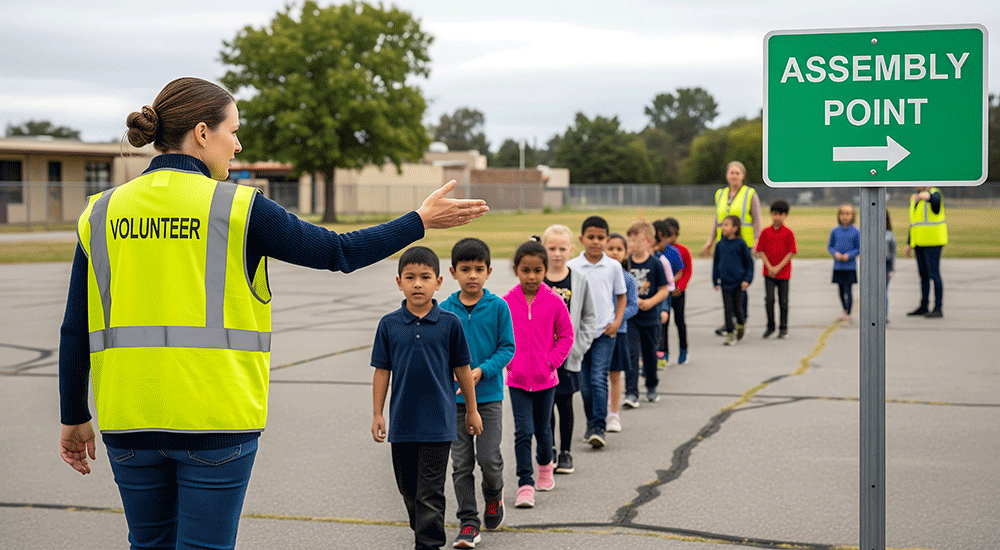
When I first started working in schools, response drills for violent incidents were rare, uncomfortable, and often avoided altogether. Fire drills, on the other hand, were routine—scheduled, practiced, and expected. Everyone knew where to go, what to do, and how to respond without panic.
Over time, I’ve come to believe that this imbalance no longer makes sense.
I grew up in Collinwood, Ohio—the site of the 1908 Lakeview School fire that killed 172 children and 2 teachers. That tragedy became a turning point for school safety in America, leading to the fire codes, exit requirements, and mandatory drills we now take for granted. Fire drills prepare us for a risk that is statistically high in frequency but—thanks to decades of rigorous code and practice—historically low in lethality. In fact, there has not been a mass-casualty school fire in the United States since 1958.
Decision-based response training, however, prepares us for a risk that is statistically rare but uniquely catastrophic. The difference isn’t which danger is more likely; it’s which danger demands immediate, informed action when seconds matter.
As someone who has spent years working in schools and responding to crises, I believe this plainly: schools should be practicing decision-based response scenarios as often—if not more often—than traditional fire drills. This isn’t about fear. It’s about competence.
A Quick Word About Different Decision-Based Response Programs
When this topic comes up, people often focus on program names. ALICE is perhaps the most widely recognized, but it is only one example of a broader category of decision-based response training.
Whether a school uses ALICE, Run/Hide/Fight, CRASE, or another framework, the core principle is the same: people need practice making decisions during violent, fast-moving emergencies instead of waiting for instructions that may never come. The name matters far less than the preparation.
Fire Drills Work Because We Practice Them
Fire drills succeed because they are familiar. Students don’t panic when the alarm sounds because they’ve done it before. We don’t run fire drills because we expect a fire tomorrow; we run them because if one ever happens, hesitation costs lives. Repetition turns chaos into movement.
Violent attacks create chaos as well—but unlike fire, violence adapts. It moves. It targets people, not exits. And yet we often treat violent incidents as unthinkable anomalies instead of emergencies that deserve the same level of preparation.
What We Learn Young Stays With Us for Life
Discussion Questions
These questions are designed to help SROs lead a conversation with their school administration and staff:
- Assessing Familiarity: If a fire alarm sounds right now, every student and staff member knows exactly what to do. Can we say with 100% certainty that the same level of clarity exists for a violent incident response?
- Evaluating the “Inaction” Phase: In past national incidents, hesitation or waiting for “allowed” movements caused critical delays. How can we better authorize our staff to make situational, life-saving decisions without waiting for a central command?
- Reframing Trauma: Does our current approach to training focus on the “scare factor,” or are we focusing on building “practiced competence” that replaces helplessness with empowerment?
- Frequency vs. Lethality: We practice fire drills because they are high-frequency, yet mass-casualty fires haven’t occurred in a U.S. school since 1958. How do we justify practicing less for a risk that is statistically rarer but far more catastrophic?
As adults, most of us instinctively know what to do when a fire alarm goes off. That didn’t happen by accident; it happened because fire response was practiced repeatedly when we were young.
The reality is that most adults today have never been taught how to think or act during a violent attack. Teaching students decision-based response skills doesn’t just prepare them for school emergencies; it gives them life skills they carry into adulthood.
Decision-Based Response Training Is Not a Script
One of the most common misunderstandings about modern response training is the belief that it’s a rigid checklist. It isn’t. Decision-based models are built on a core idea: people must be able to think, adapt, and act based on what is happening around them.
In a fire, the safest response is usually clear: evacuate. In a violent incident, the safest response depends on location, timing, access, and proximity to danger. Decision-based drills help staff and students learn how to recognize credible threats early and make situational decisions instead of waiting for permission. Those skills don’t appear automatically under stress; they are built through repetition.
Evidence of the Risk: Confusion
In after-action reviews of national school incidents, the most dangerous moments consistently stem from uncertainty. We see situations where classrooms waited too long for direction that never came, or staff hesitated because they didn’t know if moving was “allowed.” When response training remains theoretical instead of practiced, people default to inaction. Hope is not a response plan.
Practice Reduces Trauma — It Doesn’t Create It
A common concern is that practicing for violent incidents will traumatize students. That concern deserves respect—but it also needs context.
Trauma is not caused by preparation; trauma is caused by helplessness. When drills are age-appropriate, transparent, and focused on empowerment rather than fear, they reduce anxiety. The key is a professional approach: no surprise simulations, no fake weapons, and clear communication. Just like fire drills, decision-based response drills should be normalized, not sensationalized.
Final Thought
Fire drills prepared us for the last century. Decision-based training prepares us for this one. If we believe schools should be safe places for learning, then we must accept that safety requires preparation—not panic, but practiced competence.
Charles D. Popik is a veteran law enforcement professional and the author of The SRO Handbook Series. His work focuses on bridging the gap between tactical response and school culture. He can be reached at [email protected].
Note: The views expressed by guest bloggers and contributors are those of the authors and do not necessarily represent the views of, and should not be attributed to, Campus Safety.