
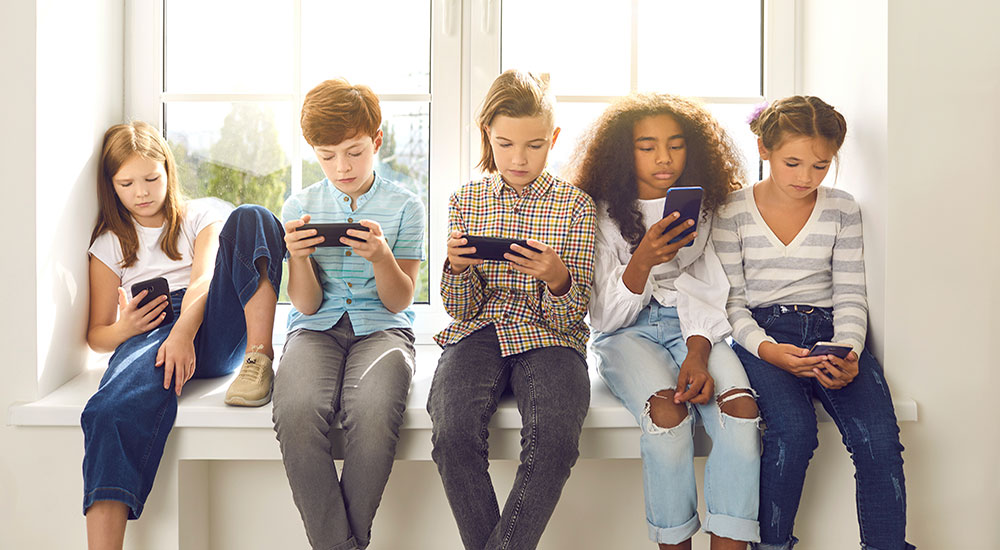
Children who have smartphones by age 12 are at an increased risk for depression, obesity, and lack of sleep, according to a new study published Monday in the journal Pediatrics.
The researchers looked at data from more than 10,500 participants in the Adolescent Brain Cognitive Development Study, which is an ongoing study assessing brain development in children throughout adolescence, ABC reports. They specifically analyzed data from children between ages nine and 16, collected from 2016 to 2022, to see how smartphone ownership and the age at which they received their first smartphone affected their health.
Overall, the researchers found 12-year-olds who had a smartphone had a 1.3 times higher risk of depression, a 1.4 times higher risk of obesity, and a 1.6 times higher risk of insufficient sleep. Even children who did not have a phone at the age of 12 but received one a year later reported poorer mental health and sleep quality than kids of the same age who didn’t have a smartphone.
RELATED: Surgeon General Warns of Social Media Impact on Youth Mental Health
Additionally, the earlier the age at which a child received a smartphone, the greater the risk of developing the problems increased by about 10% for each year earlier age, starting as young as age four.
Dr. Ran Barzilay, lead author of the study and a child and adolescent psychiatrist at Children’s Hospital of Philadelphia, said that while the study only proves association, not causation, it adds to a growing body of evidence linking smartphone use among children to adverse health outcomes. For instance, citing a survey of adolescents, a June 2023 advisory from then U.S. Surgeon General Dr. Vivek Murthy said social media may cause and perpetuate body image issues, affect eating behaviors and sleep quality, and lead to social comparison and low self-esteem.
As a result of these findings, cell phone bans and restrictions in K-12 schools continue to gain momentum as well. As of Dec. 2025, 35 states and Washington, D.C., have signed or already enacted laws or policies regarding student cell phone usage in classrooms.
When Are Kids Ready for Cell Phones?
According to a Pew Research Center survey, 95% of teens ages 13-7 have a smartphone, as well as 60% of 11- to 12-years-olds and approximately 33% of children ages eight to 10.
“A kid at age 12 is very, very different than a kid at age 16,” Barzilay told the New York Times. “It’s not like an adult at age 42 versus 46.”
Barzilay said the purpose of the new study was not to shame parents who have already given their children smartphones but to highlight that the devices play a role in the health of a child.
“Our findings suggest that we should view smartphones as a significant factor in teen health, approaching the decision to give a child a phone with care and considering potential impacts on their life and health,” he wrote in a news release.
RELATED: Which States Have Banned Cell Phones in Schools?
Determining if a child is ready for a cell phone isn’t an exact science, experts say. The decision depends on the individual child and the parents’ readiness to manage the new responsibility.
The American Academy of Pediatrics (AAP) recommends talking with your children about family rules and expectations beforehand, such as not using phones in their bedroom or at the dinner table, and reminding them that getting a cell phone does not equal getting social media.
The AAP also offers a phone readiness quiz to help parents make a decision. Here is another resource from Dr. Jenny Radesky, an Assistant Professor in Developmental Behavioral Pediatrics at the University of Michigan Medical School, on determining when a child may be ready for a cell phone.